Too Busy for Risk? A Causal Analysis of March Madness and Financial Risk Control
Causal inference study on how NCAA March Madness affects financial risk control using VaR violations
View Full Report: Link to Report
Tools and Methods
Technologies: Python, pandas, Value at Risk (VaR), Propensity Score Estimation, AIPW (Augmented Inverse Probability Weighting), Event-Based Causal Inference, Data Visualization
Concepts: Causal Inference · Behavioral Finance · Risk Management · Statistical Modeling
Overview
I completed this project for the Risk Practice course in the Rutgers MSDS program. I investigated how public attention during NCAA March Madness could affect financial risk control. I used Value at Risk (VaR) violations to measure risk model failures and applied causal inference methods to understand if investor distraction had any effect.
Research Idea
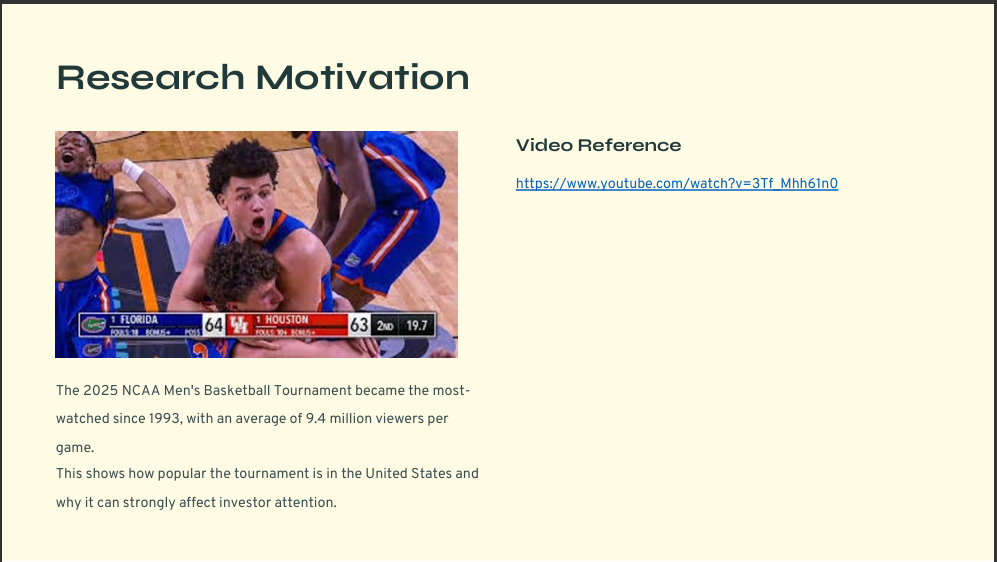
Inspired by the Rubin Causal Model and behavioral finance research, I treated March Madness game days as a special event that might influence investor behavior. I used Augmented Inverse Probability Weighting (AIPW) to estimate how the chance of risk control failure changed when a company was exposed to this kind of attention shock.
Goals
- Test if investor distraction during March Madness increases the chance of VaR violations
- Measure how violation rates change in the days after game days
- Compare tournament-related companies (treatment group) with unrelated companies (control group) using balanced data
Methodology
Treatment: I labeled a trading day as a “Game Day” if it overlapped with the NCAA tournament schedule
Outcome: A VaR violation happened when the actual stock return fell below the predicted 90 percent risk threshold
Propensity Score: I used past return and volatility to estimate the probability of treatment for each observation
Causal Inference: I applied AIPW to estimate both the probability and intensity of risk model failure after exposure
Visualization: I created plots to show return trends, violation timing, and group-level comparisons
Key Findings
- I found that tournament-related companies had fewer VaR violations on game days. This suggests they may receive more attention or risk oversight instead of being ignored.
- However, violations increased in the days after game days. This supports the idea of a delayed distraction effect.
- My results show that even short-term attention shifts can affect the performance of risk control systems.
Why It Matters
This project helped me connect causal inference techniques with real-world market behavior. It shows that behavioral factors like attention and emotion can influence financial outcomes. I believe this approach can be applied to other large events and can help risk managers prepare for periods when human focus is limited.